The numbers on the label are only a piece of the picture
There's a reason us protein powder shoppers have become label-literate. We know to check the grams, scan the ingredient list, clock the amino acid profile. But there's one thing most labels don't tell us — and it might be the most important variable of all: how much of that protein can your body actually use?
Protein absorption isn't automatic
When you consume protein, your digestive system has to break it down into amino acids small enough to cross into the bloodstream and reach the cells that need them. This process — digestion, absorption, and utilization — is where the gap between what a label promises and what your body gets can widen.
A protein powder can list 25 grams per serving and deliver significantly less functional benefit if the protein isn't bioavailable. Bioavailability is the measure of how much of a nutrient actually makes it into circulation and gets used. It varies by protein source, processing method, and critically, by what else is in the formula.
Where digestive enzymes come in
The body produces its own digestive enzymes to break down food — proteases for protein, lipases for fat, amylases for carbohydrates. But the process isn't always complete, particularly with plant-based proteins, which tend to have more complex structures than animal-derived sources and can be harder to fully digest.
This is why enzyme complexes have become one of the more meaningful additions to a protein formula — not as a marketing flourish, but as a functional one. When specific enzymes are added to support protein breakdown, more of that protein gets digested into the amino acids your body can actually absorb and use. It shows up in recovery, in muscle protein synthesis, in how your body responds to training over time.
The plant protein gap
Plant proteins face a particular bioavailability challenge. Unlike whey — which is rapidly digested and contains a high concentration of leucine, the amino acid most responsible for triggering muscle protein synthesis — plant proteins vary widely in their digestibility. Some sources are naturally lower in certain amino acids. Others have structural properties that make them harder for the body to break down efficiently.
This is why the formulation around a plant protein matters as much as the protein itself. A well-designed plant protein doesn't just count grams — it accounts for what happens to those grams once they're inside the body.
What to actually look for
If you're evaluating a protein powder — plant-based or otherwise — the grams per serving are a starting point, not a finish line. Worth looking at: the protein sources (single or multi-source blend, since variety tends to improve the amino acid profile), whether a digestive enzyme complex is included, and how the product is processed, since some methods preserve more of the protein's natural structure than others.
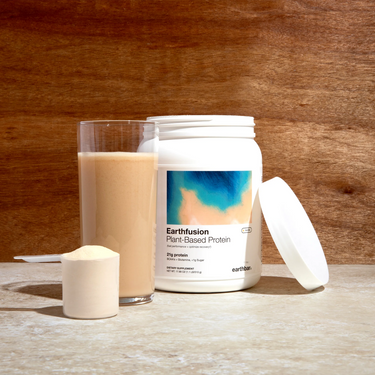
Earthfusion was formulated with a digestive enzyme blend specifically to address the absorption gap — so the 21 grams on the label are doing the work they're supposed to do.
The best protein isn't always the one with the biggest number. It's the one your body can actually use.